
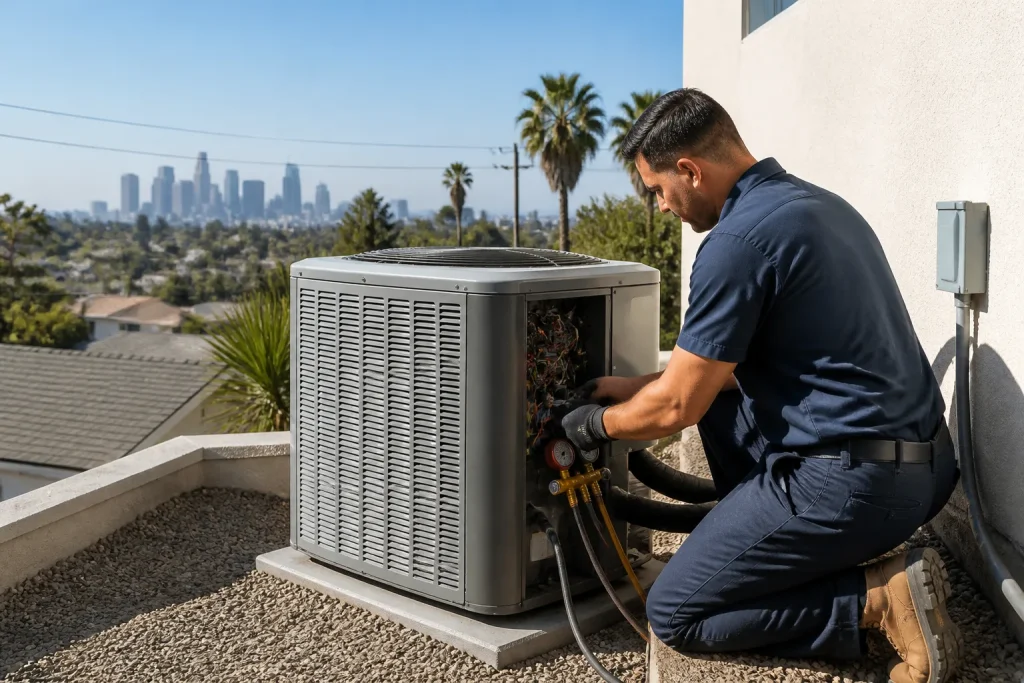
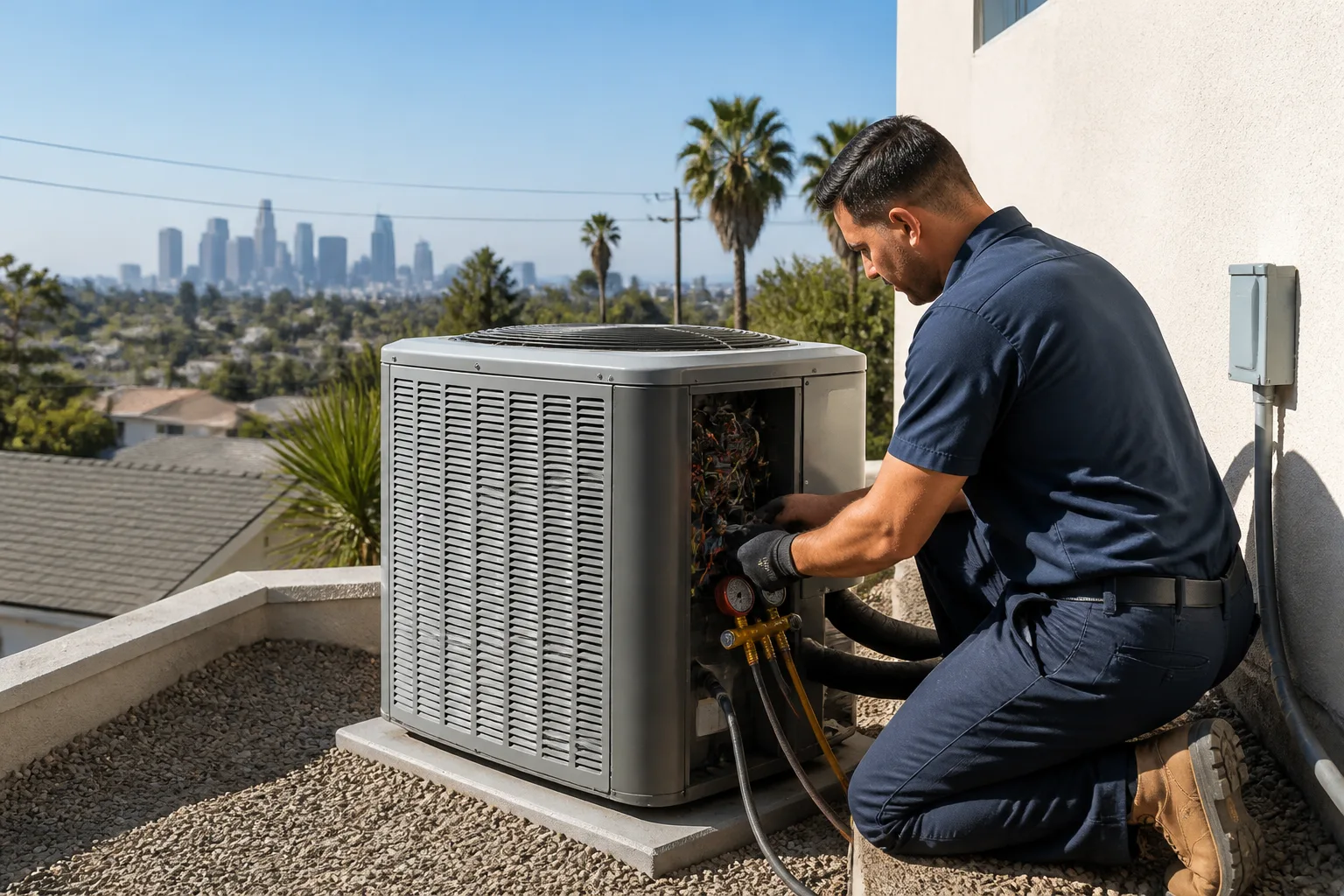
Trane AC Repair in Los Angeles: A Homeowner’s Guide
A Trane XV18i that throws a fault code isn’t giving you a guess, it’s giving a trained technician a specific component indictment. The repair goes sideways when the technician doesn’t know how to retrieve and read it. In Los Angeles, where Trane units run hard from May through October, that difference determines whether you pay for one repair or three. Here’s what you need to know before your Trane system acts up, and what actually drives the cost of fixing it in LA.
What Makes Trane AC Repair Different in Los Angeles
Trane builds its equipment differently than most brands, and that shows up at the repair bench. The XL and XV product lines, the XV18i, XV20i, XL18i, and their heat pump siblings, use a communicating control system. In plain terms, the thermostat, outdoor unit, and indoor air handler send data back and forth over a digital signal rather than simple on/off commands.
Why does that matter for your repair bill? Because when something fails, the system logs a specific fault code. A technician who knows Trane’s diagnostic protocol can pull that code and go straight to the offending component. A technician who doesn’t will often start swapping parts based on symptoms alone. We’ve seen homeowners in Los Angeles pay for two or three parts before the actual problem got fixed, because the first technician was guessing.
In our experience, roughly half the Trane repair calls we take in Los Angeles involve a system that was misdiagnosed on the first visit. The homeowner didn’t need a new compressor, they needed a $40 high-pressure switch that the fault code had identified all along. The equipment wasn’t the problem. The diagnostic approach was.
Ask this question before you book any Trane repair: “Do your technicians hold Trane ComfortSpecialist or equivalent brand certification?” That certification means the tech has been trained on Trane’s specific communicating protocol, not just generic HVAC fundamentals. For a conventional single-stage Trane unit, a solid general technician is usually fine. For an XV or XL series communicating system, brand-specific training is the difference between a one-visit fix and a parts cannon.
What Trane AC Repairs Actually Cost in Los Angeles
Most Trane repairs in the LA market fall between $180 and $650 depending on the part and the system type. Communicating equipment runs slightly higher on labor because diagnostics take longer. Here’s a realistic range for the five most common Trane AC repairs we handle across Los Angeles:
- Capacitor replacement: $140 – $280. The capacitor is a small cylinder that gives the compressor and fan motor the electrical kick they need to start. Los Angeles heat, especially in the Valley, cooks these things. When they fail, the outdoor unit hums but won’t start.
- Condenser coil cleaning: $120 – $220. LA’s particulate air quality, the dust, the fine grit that builds up on everything, clogs condenser coils faster than homeowners expect. If your electric bill creeps up every summer and the system runs longer to hit the set temperature, the coil is probably crusted over.
- Refrigerant leak repair: $300 – $700 including refrigerant. Loss of cooling fluid, the refrigerant your system needs to pull heat out of the house, usually happens at Schrader valve connections, those fill ports on the outdoor unit, or at braze joints. LA’s temperature swings put constant expansion and contraction stress on those seals.
- Condenser fan motor replacement: $280 – $520. The motor that spins the fan over the outdoor coil. Outside air in Los Angeles is rough on the bearings.
- Communicating control board replacement: $450 – $900 on XV and XL series equipment. These boards are the brain of the system, and they’re expensive because they’re Trane-specific. A generic board won’t talk to the thermostat properly.
The numbers shift by neighborhood. Repairs in Santa Clarita or the western San Fernando Valley tend to run at the higher end because technicians are driving farther. Central LA and the South Bay are usually mid-range. Either way, you should have the price in writing before any work begins. If a company won’t put a number on paper before they start, that’s your signal to call someone else.
Common Trane AC Failures in Southern California
After years of repair work on Trane equipment across Los Angeles, we can map the failures to the climate. Three issues dominate.
Capacitor heat soak. Capacitors degrade faster when ambient temperatures stay high. In Los Angeles, a rooftop condenser can hit 140 degrees on a July afternoon. The capacitor sits right next to the compressor, absorbing that heat day after day. When it finally gives out, the system either won’t start or the compressor draws excessive current and trips a breaker. We pulled a swollen, heat-distorted capacitor out of a Trane XR16 in Tarzana last month that had been installed less than three years earlier. That’s a heat problem, not an equipment problem.
Condenser coil fouling. LA air carries fine particulate that settles into the coil fins and bakes on. As the insulating layer builds, the system loses its ability to reject heat. Refrigerant pressures climb, the compressor runs hotter, and eventually a safety switch trips. The fix is straightforward, a proper coil cleaning with a solvent designed for the job, but it has to be done before the heat damage compounds. A dirty coil left for a full season turns a $180 cleaning into a $500 component failure.
Schrader valve refrigerant loss. The Schrader valve is the fill port where refrigerant gets added. The tiny core inside that valve wears out, especially on systems that have been serviced a few times. We respond to more low-refrigerant calls in Los Angeles than anything else, and at least half of them trace back to a leaking Schrader core, not a major line set problem. The fix is often under $100 in parts, but the diagnostic work to confirm the leak source is where the labor dollars go.
Understanding the Trane Warranty Before You Repair
Trane’s standard warranty covers the compressor for 10 or 12 years and other parts for 10 years, but only if the system was registered within 60 days of installation by the original owner. Miss that window, and the parts warranty drops to a base 5-year term. It’s a detail that costs Los Angeles homeowners real money every year.
Here’s what you need to know.
- Registration is not automatic. Your contractor has to submit the registration, or you have to do it yourself. If you bought a house with a Trane system already installed, the warranty may not have transferred properly.
- Repairs by uncertified technicians can void coverage. Trane’s warranty language specifically requires service by a licensed HVAC contractor. If an unlicensed handyman opens the refrigerant circuit and damages something, Trane can deny the claim. We’ve seen it happen.
- Warranty covers parts, not labor. The compressor might be free under warranty. The 4 to 6 hours of labor to recover refrigerant, replace the compressor, evacuate the lines, and recharge the system is still on you. In Los Angeles, that labor typically runs $800 – $1,400.
To verify your unit’s registration status, you’ll need the model and serial number from the data plate on the outdoor unit. Trane has a warranty lookup tool online, but honestly, calling Trane directly at their owner support line is faster. Have the serial number ready. If the unit wasn’t registered, you can sometimes register it late with proof of the original installation date, but don’t count on it.
Repair vs. Replace: When the Math Tips
A Trane unit in Los Angeles runs hard. If your system is over 15 years old and the repair quote lands over $1,500, you should run the numbers on replacement. Here’s the honest math: a compressor replacement on a 14-year-old Trane costs $2,500 to $4,000 when you factor in the refrigerant, labor, and the fact that you’re putting a new heart in an old body. The other components, the coil, the fan motor, the control board, all have the same mileage on them.
Meanwhile, a new high-efficiency Trane heat pump in Los Angeles runs $8,000 to $14,000 installed, before rebates. Southern California Edison and LADWP both run efficiency rebate programs that can knock $500 to $2,000 off that number. The new unit carries a fresh 10-year parts warranty with proper registration. And the efficiency gain, jumping from a SEER 13 to a SEER 18 or higher communicating system, cuts the summer electric bill noticeably in LA’s long cooling season.
The rule of thumb we give Los Angeles homeowners: if the repair is under $1,000 and the system is under 12 years old, fix it. If the repair is over $1,500 and the system is over 12 years old, get a replacement quote and compare. The decision gets easier when you have both numbers in writing in front of you.
When to Call a Pro
You can diagnose a few things yourself before calling for Trane AC repair in Los Angeles. Check the breaker. Check the thermostat batteries. Listen for a hum that suggests the unit is trying to start. But don’t open the cabinet, don’t touch the capacitor, and don’t mess with the refrigerant lines. A capacitor holds enough charge to knock you on your back even with the power off. Refrigerant under pressure can cause frostbite burns. If the basic checks don’t solve it, you’ve done your part. Call someone who can retrieve the fault code.
If you’re in Los Angeles and need a hand, Dalton Heating & Air offers free estimates, call (361) 306-9515. We’ll put the price in writing before any work starts, and we stand behind every repair with a full-year written guarantee. If the work doesn’t hold, we come back at no charge.
The Bottom Line
Trane equipment is built to last in Los Angeles heat, but the sophisticated controls on XV and XL series units mean your repair is only as good as the technician reading the codes. Ask about brand-specific training before you book. Check your warranty registration status before you assume parts are covered. Get the price in writing before work begins. And don’t let a misdiagnosis turn a $300 fix into a $3,000 parts-spree.
If you’re in Los Angeles and need Trane AC repair, Dalton Heating & Air offers free estimates, call (361) 306-9515. We service all nine major residential HVAC brands and our technicians are factory-trained on Trane’s communicating diagnostic protocol. You can also learn more about our AC Repair in Los Angeles services, or check out Heat Pump Installation in Los Angeles and Furnace Repair in Los Angeles if you’re weighing broader HVAC work. And if you’re comparing brands before a replacement, we’ve worked on all of them, including York, Daikin, and Bryant, so we can give you a straight answer on what holds up in Southern California.
Frequently Asked Questions
Most Trane AC repairs in Los Angeles run between $180 and $650. Simple fixes like capacitor replacement are on the lower end, while communicating control board replacement on XV or XL series equipment can push toward $900. Labor is generally higher for communicating systems because diagnostics take longer.
For conventional single-stage Trane units, a skilled general HVAC technician is usually sufficient. For XL and XV series communicating systems, you want a technician with Trane-specific diagnostic training, like Trane ComfortSpecialist certification, because the fault code protocol is proprietary and easy to misread without it.
It depends. If your system was registered within 60 days of installation, key parts including the compressor are covered for 10 years. If it wasn’t registered, the base warranty drops to 5 years and may have already expired. Warranty also covers parts only, not labor, and repairs by unlicensed contractors can void coverage.
As a general rule for Los Angeles homeowners: if the repair quote is under $1,000 and the system is under 12 years old, repair it. If the repair exceeds $1,500 on a system over 12 years old, get a replacement quote and compare. New high-efficiency units qualify for SCE and LADWP rebates that can offset the cost.
Written by Marco Benitez, Owner at Dalton Heating & Air, serving Los Angeles since 2003.
Need HVAC Help?
Call Dalton Heating & Air - licensed & insured, here with fast after-hours help in Los Angeles.
(361) 306-9515