
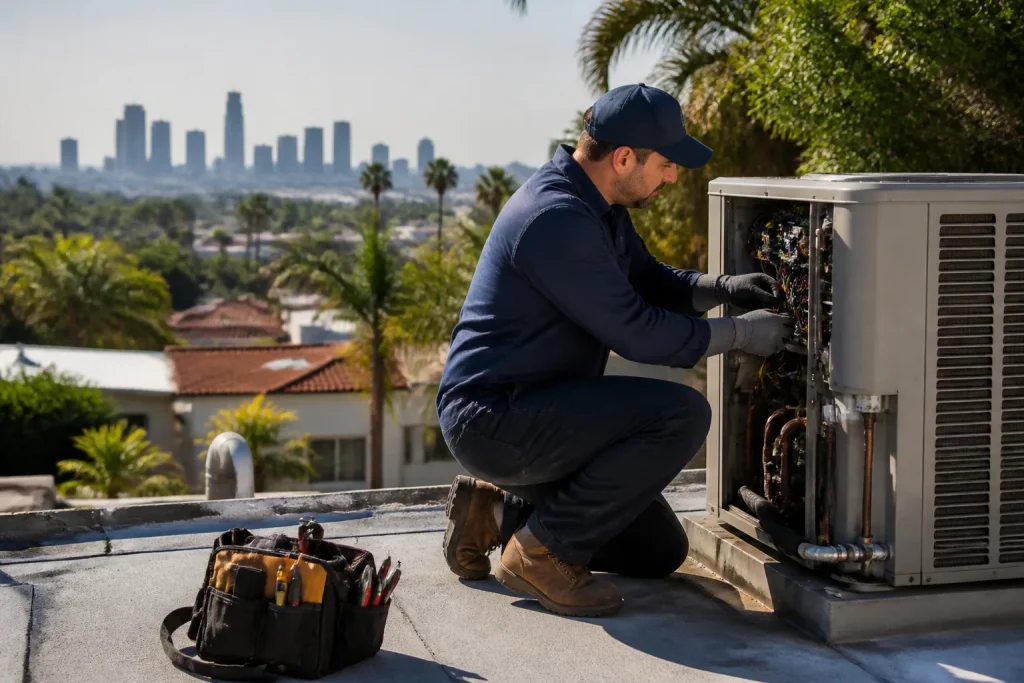
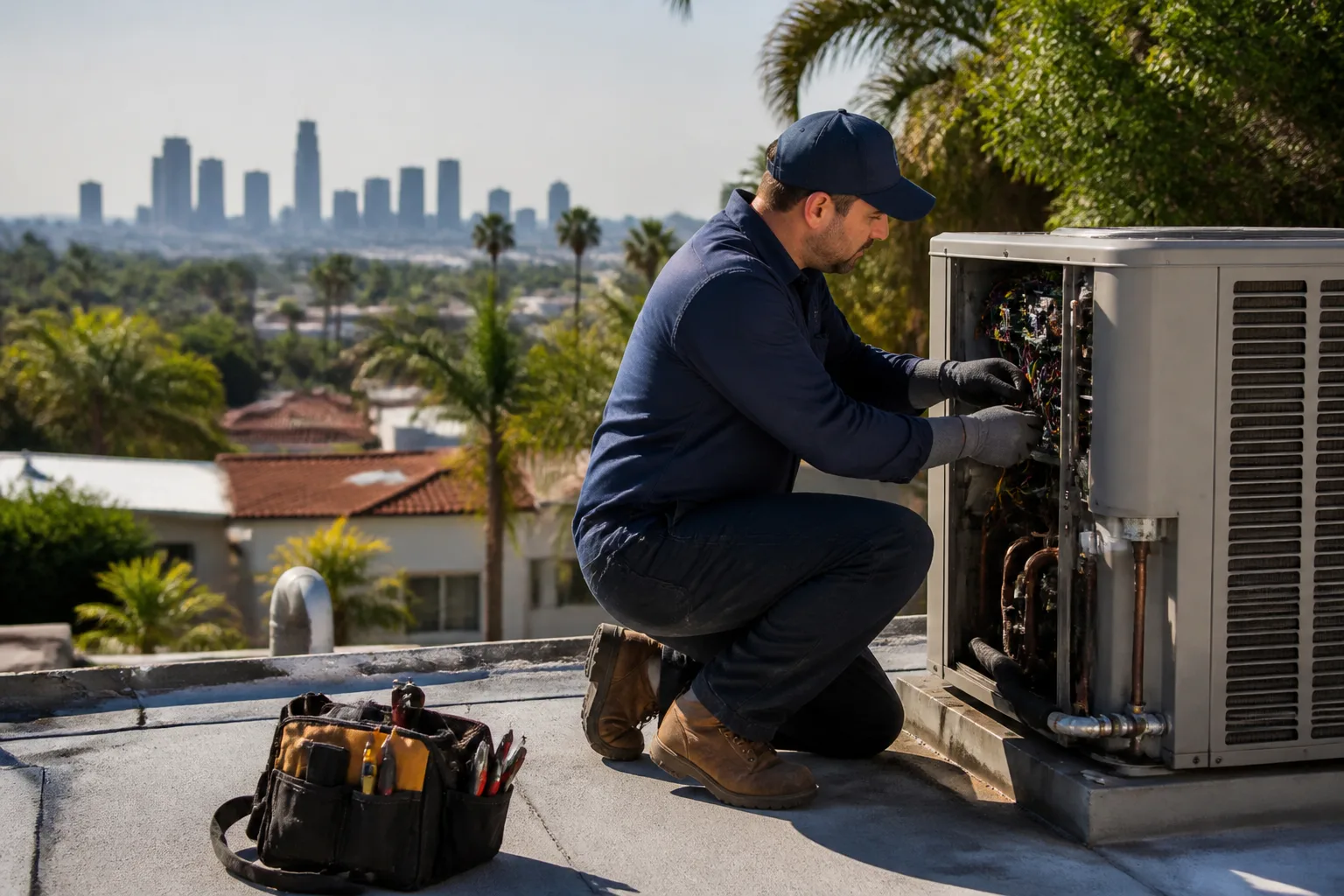
Preparing Your Home’s HVAC for Winter in Los Angeles
Preparing your HVAC for winter in Los Angeles takes about 45 minutes, and it prevents the most predictable service call of the year: the first cold night in November when the furnace fires up and fails. The number-one cause of no-heat calls across Los Angeles every fall isn’t a sudden breakdown. It’s a component that was already marginal in March, sat dormant through nine months of heat, and couldn’t handle the first cold start of the season. Run through the checks below in October, and you’ll catch the ignitor on its last leg, the gas valve starting to stick, and the heat exchanger crack before any of them strand you on a 50-degree night. If you’d rather not do it yourself, call (361) 306-9515 and we’ll handle the whole pre-season checkup.
Key Takeaways
- A 45-minute October checklist stops the furnace problems Los Angeles homeowners hit every first cold snap.
- Run the furnace for five full minutes before you need it, and pay attention to the startup sequence.
- During Santa Ana season, a MERV 13 filter can choke an older furnace. Match the filter to the system, not the marketing.
- Heat pump owners need a defrost cycle test, not just a thermostat flip.
- Do clear debris from the condenser coil. Do not cover the outdoor unit for winter.
Run the Furnace Startup Sequence in October
The single most useful thing you can do to prepare for winter in Los Angeles is run your furnace for five full minutes while the weather is still warm and your schedule is not hostage to a cold house. You’re listening for a specific sequence. Here’s what a healthy startup sounds like on most furnaces, including the Goodman, Rheem, and York units we service across the city:
- Inducer motor spins up. You’ll hear a low hum or a soft whir from the exhaust blower near the top of the furnace. It should run smoothly, no grinding or rattle.
- Ignitor glows or sparks. Hot surface ignitors glow orange for several seconds before the gas valve opens. If the ignitor is weak, the sequence stalls here.
- Gas valve opens with a soft click, then a low whoosh as the burners light. A loud boom or a delayed ignition sound means the gas is pooling before it lights – that’s a call-us-soon noise, not a normal one.
- Blower motor kicks on after 30 to 60 seconds. You’ll feel warm air at the registers. The blower should be smooth and steady, not surging.
The smell you notice during a first fire-up matters. A faint dusty smell for the first few minutes is completely normal in Los Angeles homes because dust settles on the heat exchanger all summer. That smell should fade and disappear within five to ten minutes. What should not happen: a smell of rotten eggs (natural gas), a smell that gets stronger, or visible soot around the registers. If you get rotten eggs, shut the furnace off at the thermostat, leave the gas valve alone, and call us or your gas utility. That’s not a pre-season nuisance. That’s a gas leak.
We pulled a furnace filter out of a unit in Sherman Oaks last fall that was so packed with ash from the Santa Anas it looked like a piece of felt. The homeowner said the furnace had been “running weak” all winter. It wasn’t the furnace. It was suffocating.
Match Your Filter to Your Furnace, Not the Marketing
Santa Ana winds push dust, ash, and fine particulate through every neighborhood in Los Angeles from September through November. That makes filter changes more frequent here than in most climates, and it makes filter choice more consequential. The big mistake we see every fall is a homeowner installing a high-MERV filter, usually a MERV 13, on a furnace that was never designed for that much restriction.
Here’s the trade language and the plain version: MERV stands for Minimum Efficiency Reporting Value. It measures how small a particle the filter catches. Higher MERV catches more, and in a city with air quality challenges like Los Angeles, that sounds great. But higher MERV also means more resistance to airflow. That resistance is called static pressure, and most older residential furnaces have a static pressure budget that a MERV 13 filter blows straight through. The result is reduced airflow across the heat exchanger, which makes the furnace run hotter, trip its high-limit switch, and shut down mid-cycle. On a cold night, that looks like a furnace that “works for a while and then quits.”
What actually matches your system is usually a MERV 8 pleated filter, changed every 30 to 60 days during Santa Ana season and every 90 days the rest of the year. If you want higher filtration without choking the furnace, the right move is a standalone air purifier or a media cabinet designed for high-efficiency filters. Don’t retrofit a MERV 13 into a system with a standard one-inch filter slot and expect the furnace to keep up. Dalton Heating & Air checks static pressure as part of every pre-season tune-up, and we’ll tell you exactly what filter your system can actually handle. No guesswork.
Heat Pumps Have Their Own Winter Prep
If you have a heat pump in Los Angeles, your winter prep is different from a furnace owner’s, and it’s easy to miss because heat pumps spend most of the LA winter in cooling mode during the day and only switch to heating at night. The component that gets neglected is the defrost cycle.
When a heat pump runs in heating mode, the outdoor coil gets cold enough to frost over, even in Los Angeles when nighttime temperatures dip into the 40s. The defrost cycle handles that by temporarily reversing the refrigerant flow to melt the ice. It’s a normal part of operation, but if the defrost sensor, the reversing valve, or the defrost board is failing, the unit will ice up and stay iced, which costs you efficiency and eventually damages the compressor. The way to test it before the season: switch the thermostat to heat on a cool evening, let the system run for about 15 minutes, then watch the outdoor unit. If it frosts up, you should hear the whoosh of the reversing valve and see the frost melt within five to ten minutes. If the frost stays put, or if the system never frosts but your electric bill climbs, a defrost component is failing silently.
One more heat pump-specific check for Los Angeles: make sure the area around the outdoor unit is clear of the leaf litter and Santa Ana debris that builds up against the coil fins in the fall. A clogged outdoor coil drops efficiency in both heating and cooling modes. If you’re in Los Angeles and the heat pump hasn’t been looked at in years, our Heat Pump Installation in Los Angeles team handles pre-season checks as well as replacements.
Do the Thermostat Switchover Test
This is the five-minute check that tells you more about your system than any other single step. Set the thermostat from cool to heat, raise the set point a few degrees above room temperature, and watch and listen. On a furnace, you’re confirming that the thermostat is actually calling for heat (the screen should show a flame icon or “heat on”), that the startup sequence from Section 1 completes, and that warm air reaches the registers. On a heat pump, you’re checking that the outdoor unit kicks on in heating mode and that the air coming from the registers is warm. Not hot like a furnace. Warm. Heat pump supply air runs 85 to 95 degrees, which can feel lukewarm if you’re used to a gas furnace. That’s normal, not a problem.
What you’re really doing with those five minutes of runtime is exercising the heat exchanger. A furnace that has sat idle since March will often give you the first hint of a cracked heat exchanger on this test: a flickering flame when the blower kicks on, a smell that doesn’t go away, or a visible rust line or soot streak near the burner. A heat exchanger crack isn’t a handyman repair. It’s a safety problem that we flag during every winter prep. If you see a flickering flame pattern when the blower starts, shut the system down and call before the first cold night turns it into an emergency.
What to Do With the Outdoor Condenser (and What Not to Do)
There is one legitimate maintenance step for the outdoor condenser during a Los Angeles winter, and one persistent myth that actually damages equipment. Let’s handle the myth first: do not cover your condenser for the winter.
Some very reasonable logic sits behind the cover idea. The unit sits outside all winter, rain falls, debris accumulates, and it feels like a tarp would protect it. The problem is that a cover traps moisture underneath, which accelerates corrosion on the coil fins and electrical connections. It also creates a cozy winter shelter for rodents, and a mouse nest inside a condenser is a genuine service call. In Los Angeles, winter rain is frequent enough to keep things damp under a cover for weeks at a time. Leave the unit uncovered.
The maintenance step that is worth doing: clear debris from around the coil fins. The thin aluminum fins on the condenser reject heat by allowing air to pass over the coil. When Santa Ana winds push leaves, pine needles, and dust against the coil, the unit has to work harder to do the same job. Use a garden hose on a gentle setting to rinse the coil from the outside, not a pressure washer. A pressure washer bends the fins flat and reduces airflow permanently. Clear the area around the unit, trim back any vegetation within about two feet, and make sure the unit is level. A condenser that has settled out of level puts uneven wear on the compressor. If your outdoor unit has been fighting LA’s fall debris season for years, we can give it a proper coil cleaning as part of a winter prep visit.
When to Call a Pro
Most of what we’ve covered is within reach of a careful homeowner with a flashlight and five minutes. But there are points where calling Dalton Heating & Air is the right move, not the cautious one. If you smell natural gas during the startup test, call us immediately. If the furnace lights but the flame flickers or rolls out when the blower kicks on, that’s a heat exchanger problem and a carbon monoxide risk, not a tune-up item. If the heat pump ices up and stays iced, the defrost system needs diagnosis. If the system simply won’t start and you’ve confirmed the thermostat is calling and the breaker is on, stop guessing and get a technician who can read the fault codes.
Every technician we send in Los Angeles is background-checked, uniformed, and factory-trained to service the major residential brands most common here, including Daikin, Goodman, Rheem, York, and the others. The price goes in writing before any work starts, every repair carries a written one-year guarantee, and if the repair fails in that year, we come back at no charge. That’s the Garrison Standard, and it applies on every job we run, from a simple filter check to a full Furnace Repair in Los Angeles to a new system installation.
The Bottom Line
Winter in Los Angeles is short, so furnace problems cluster into a narrow window. The furnace sits unused from late March through October, then fires up on the first 50-degree night and every marginal component announces itself at once. You can get ahead of that by running the startup sequence in October, matching the filter to your system’s actual static pressure, testing the heat pump defrost cycle, doing the thermostat switchover test, and clearing debris from the outdoor coil without covering it. Forty-five minutes of checking now beats a cold night, a dead furnace, and an emergency call later.
If you’re in Los Angeles and want a professional pre-season checkup, or if you run these checks and something doesn’t look right, Dalton Heating & Air offers free estimates and same-day diagnosis. We’re also your resource for AC Repair in Los Angeles and everything else residential HVAC. Call (361) 306-9515 and we’ll get it squared away before the first cold snap.
Frequently Asked Questions
No. Covering the condenser traps moisture against the coil and electrical components, which accelerates corrosion and invites rodents. The units are built to sit outside uncovered. Clear debris from around the coil and keep vegetation trimmed instead. If you’re in Los Angeles and want the coil professionally cleaned, call (361) 306-9515.
Every 30 to 60 days during the active Santa Ana wind months, which in Los Angeles run roughly September through November. A MERV 8 pleated filter is the right match for most residential furnaces. If you want better filtration, consider a dedicated media cabinet or air purifier rather than raising the MERV rating beyond what your system’s airflow can support. Call (361) 306-9515 if you’re not sure what filter fits your system.
Dust settles on the heat exchanger during the months the furnace sits idle, and the first fire-up of the season burns it off. A faint dusty smell for the first five to ten minutes is normal. A rotten egg smell is not, and it means natural gas is present. Shut the system down at the thermostat and call for diagnosis immediately. If you’re in Los Angeles, Dalton Heating & Air answers live 24/7 at (361) 306-9515.
Most pre-season furnace and heat pump tune-ups in Los Angeles run $89 to $189 depending on the system type and what’s included. Dalton Heating & Air provides a written price before any work starts, and every repair we perform carries a written one-year guarantee with a free return visit if the repair fails. Call (361) 306-9515 for a specific quote on your system. Estimates are free.
Written by Marco Benitez, Owner at Dalton Heating & Air, serving Los Angeles since 2003.
Need HVAC Help?
Call Dalton Heating & Air - licensed & insured, here with fast after-hours help in Los Angeles.
(361) 306-9515