
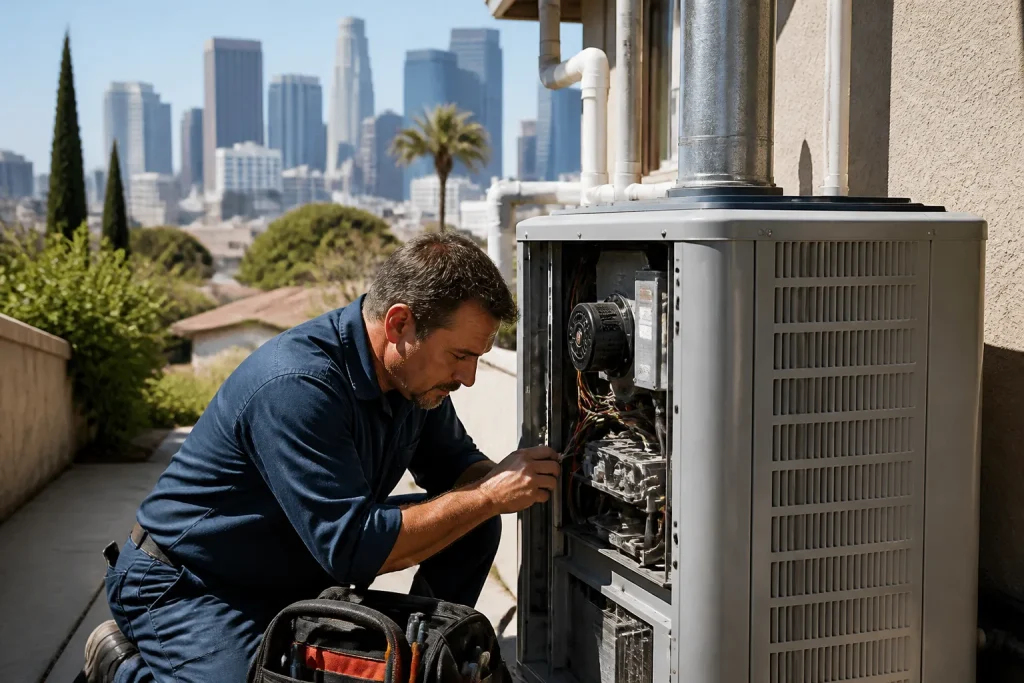
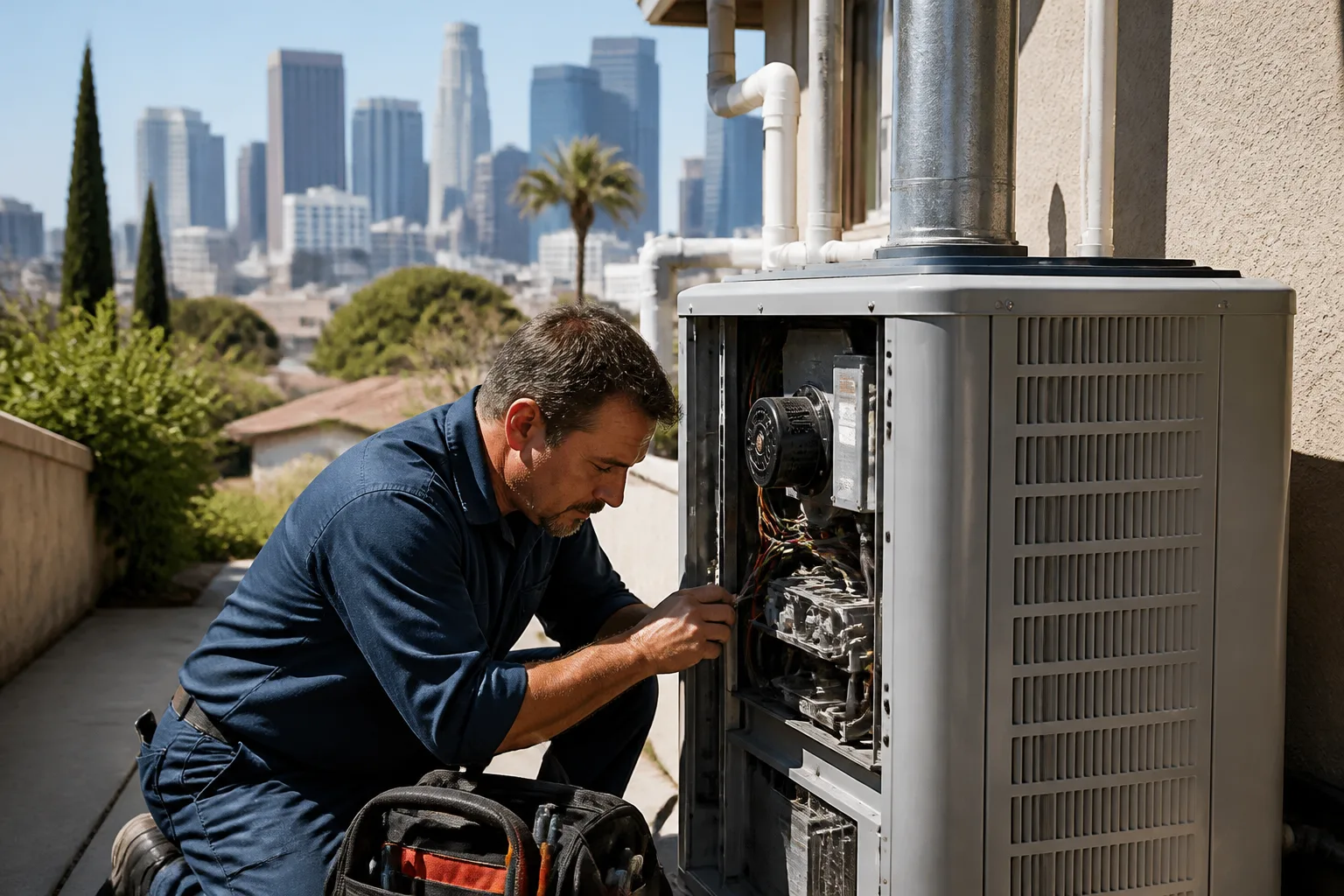
Furnace Repair: Repair or Replace? How Los Angeles Homeowners Decide
A furnace in Minneapolis logs roughly 2,000 run-hours a year. The same unit in Los Angeles might log 300. So when a repair tech tells you an LA furnace is “too old” at 15 years, they’re using a calendar, not a runtime meter. In most Los Angeles homes, the honest answer is: repair it, but only after someone has actually measured the heat exchanger and tested the control board. If you’d rather skip the detective work, call Dalton Heating & Air at (361) 306-9515 and a background-checked tech will give you the full picture in writing.
Here’s the thing nobody tells you about furnace repair in Los Angeles. The repair-or-replace math that works in Minnesota does not translate here. Not even a little. And if you follow the generic advice from a national HVAC blog, you’ll likely replace a furnace that had years of life left, or keep patching one that should have been retired. Let’s get into the specifics.
Why Los Angeles Furnaces Age Differently Than the National Average
The standard industry line is that a furnace should be replaced at 15 to 20 years old. That’s reasonable advice in Chicago or Boston, where a furnace runs hard from October to April. But Los Angeles weather means your furnace might fire up only 30 to 60 mornings a year, and for short stretches at that. Let’s put real numbers on it.
Heating degree days (HDD) measure how much and how long outside temperatures stay below 65°F. Minneapolis averages around 7,800 HDD annually. Los Angeles averages roughly 1,200 HDD, and that’s not spread evenly, it clusters on December and January mornings. What this means for your furnace is that after 15 years, an LA unit may have accumulated only 4,500 to 5,000 total run-hours. A furnace in Minneapolis hits that number in under three years.
So when a tech glances at the manufacturer sticker and says “it’s 15 years old, you’re due for a replacement,” that’s like junking a car with 40,000 miles because the paint faded. The age matters less than the wear pattern. Some components in LA furnaces actually fail faster from underuse: blower bearings dry out, capacitors lose their charge from sitting idle, and spiders and corrosion settle in the burner assembly during long off-seasons. In our experience, a 15-year-old LA furnace often has a healthy heat exchanger and a tired blower motor. The repair is a few hundred dollars. The replacement is six to ten thousand. Before you spend that spread, get the two inspections below.
The Heat Exchanger Crack Test: The Non-Negotiable Inspection in LA Homes
A heat exchanger is the metal chamber that separates the burner flame from the air you breathe. When it cracks, carbon monoxide can enter your home. This is not a “we’ll keep an eye on it” situation. A cracked heat exchanger is the one hard stop that flips the decision from repair to replace, because no reputable shop will patch a compromised exchanger and we won’t either.
Los Angeles has an older housing stock than most people realize when it comes to HVAC. Mid-century homes in Mar Vista, Westchester, and the San Fernando Valley often still run furnaces installed when those neighborhoods were built. That’s 40, 50, sometimes 60 years on the original unit. The heat exchangers in those old furnaces were heavy-gauge steel, durable, but not eternal. Thermal expansion and contraction, even at just a few hundred run-hours a year, eventually causes stress fractures at the weld points.
What a real inspection looks like: a technician removes the blower access panel, lights the burners, and watches the flame. If the flame flickers or changes color when the blower kicks on, that indicates air disturbance from a breach in the metal. We also use a combustion analyzer to measure carbon monoxide at the supply registers when possible. A healthy furnace should read zero. Any measurable CO at the register is an immediate shutdown and a discussion about replacement, not repair.
One thing to know for insurance purposes: if a crack is confirmed, the furnace is red-tagged and cannot legally be put back into service in California. You’ll want that in writing from whoever diagnoses it, because your homeowner’s insurance may ask for documentation if a related claim ever occurs. A verbal “you need a new furnace” does not protect you. A written diagnosis does.
The Serial Failure Pattern: When One Repair Becomes Three
Here’s a pattern we’ve pulled out of garages from Silver Lake to Pasadena more times than we can count. A homeowner calls because the furnace won’t start. The ignitor is replaced. Two weeks later, the blower motor seizes. Replaced. A month later, the pressure switch is stuck open. Replaced. Now the homeowner is three service bills into a furnace that still works intermittently, and someone tells them “these things just happen when a furnace gets old.”
That explanation is almost always wrong. When an ignitor, blower motor, and pressure switch fail in the same season on a furnace under 20 years old, the root cause is usually the control board. The board is the printed circuit that sequences the components. When it starts sending erratic voltage or failing to close relays, it can burn out an ignitor prematurely, reduce power to the blower until it stalls, or misread the pressure switch signal. Replacing the peripheral parts without testing the board is like replacing burned-out light bulbs over and over while ignoring the faulty wiring.
A competent diagnostic approach measures what the board is actually doing: checking flame sensor microamps, verifying the ignitor is receiving proper voltage for the specified duration, confirming the blower relay closes without voltage drop. That takes a technician with a meter and the patience to use it, not someone who swaps a part and says “let’s hope.” If the board is confirmed at fault, the repair is usually $300 to $600 on most brands, and it buys the furnace years more service. If the board diagnosis is missed and you keep paying for symptom-level repairs, you’ll hit the cost of a new furnace by the third or fourth visit. That’s the real math Los Angeles homeowners need.
California Title 24 and SCAQMD: What a Replacement Actually Requires Here
If you do decide replacement is the right path, Los Angeles adds a layer that most furnace-repair articles never mention. You cannot simply swap an old furnace for any new one on the shelf. California’s Title 24 building energy standards and the South Coast Air Quality Management District (SCAQMD) rules apply. And they change what a new furnace costs, sometimes by a lot.
First, Title 24. Since October 2019, every new furnace installed in California must meet a minimum 80% Annual Fuel Utilization Efficiency (AFUE), but that’s the floor, not the target. Depending on your home’s size, existing ductwork, and permit status, a Title 24 energy compliance analysis may require a 90% or higher AFUE condensing furnace. Condensing units cost more than standard 80% furnaces, typically $1,500 to $2,500 more on the equipment side, and they often require new venting since they exhaust cooler, less buoyant flue gases. If your existing furnace vents through the roof or a metal flue, that venting may need to be replaced with a horizontal PVC pipe. That’s an added line item a verbal estimate won’t mention.
Second, SCAQMD. The district has been ratcheting down NOx emission limits on household furnaces for years. The current SCAQMD Rule 1111 requires ultra-low NOx burners on new furnaces. Most modern furnaces from Rheem, Carrier, and Bryant comply, but some budget brands sold online do not, and installing them in LA County is a violation. This is one reason the lowest internet price often isn’t installable here. When you’re comparing replacement bids, ask whether the quoted unit is SCAQMD-compliant and whether the price includes Title 24 documentation, because the permit won’t close without it.
What does all this do to your repair-vs-replace math? A basic 80% AFUE furnace in Los Angeles might run $3,800 to $5,000 installed. A 95% AFUE condensing furnace with venting changes could run $6,000 to $9,500. That’s real money, and it’s exactly why the heat exchanger and control board inspections matter. If a $400 repair keeps a compliant, functioning furnace running for two or three more LA winters, that’s a rational call.
Written Repair Estimates: The Only Way to Actually Compare
Here’s where we see Los Angeles homeowners get burned, and it has nothing to do with equipment. It’s the estimate. A tech comes out, diagnoses a bad pressure switch, and says “probably around $400, maybe less.” You approve the work. The final bill is $650 because there was a same-day trip charge, a diagnostic fee that wasn’t waived, and a “miscellaneous materials” line that appeared after the work started. That’s how a repair that should have been affordable becomes the straw that makes you say “forget it, I’ll just replace the whole thing.”
Written estimates protect you from exactly this. Before any work starts, you should have a line-item price on paper, in your hand. The actual dollar amount, not a range, not a “we’ll see.” Once you have that number, the repair-vs-replace comparison becomes simple arithmetic. Written repair price versus written replacement price, compared against the expected remaining life of the furnace. Without a written repair price, the comparison is based on guesses and on-the-spot emotional decisions. No homeowner makes their best financial choice in the middle of a cold January morning when the tech is standing in the hallway holding a clipboard.
Dalton Heating & Air operates under The Garrison Standard, which has one rule that matters most here: the price is in writing before any work begins. Always. Every repair also comes with a written guarantee for a full year, not a 30-day window. If the repair fails within that year, we come back at no charge. That’s not a promotional offer. It’s how every job has been run since 2003. And the reason we can make that guarantee is the diagnostic discipline described above. When you diagnose the root cause instead of replacing symptoms, the repair holds.
If you’re comparing a repair against a replacement, we’ll give you both prices in writing and let the numbers lead. We service all major residential brands, including Rheem, Daikin, and Bryant, so we can tell you honestly whether the parts for your existing furnace are worth buying or whether the system has hit the point of diminishing returns.
When to Call a Pro, and What We Actually See in LA Homes
You can check your air filter, make sure the thermostat has fresh batteries, and verify the gas shutoff valve is open. Those are the homeowner-level checks that cost nothing and fix a surprising number of “dead furnace” calls. But if the furnace lights and then shuts off repeatedly, smells like unburned gas, makes a grinding noise from the blower, or trips its breaker, stop troubleshooting. Gas furnaces combine flame, high voltage, and carbon monoxide risk, and a cracked exchanger with the blower running is exactly the scenario you do not want to test with a DIY video. Call a licensed professional.
One call stands out from a bungalow over in Eagle Rock. The furnace was from 1998, the homeowner had owned the house for three years, and it had never been serviced. The flame sensor was so coated that the burners would fire for four seconds and shut off. That’s a $200 repair. But more importantly, the heat exchanger was crack-free and the control board tested clean. The homeowner was stunned. Three companies had told her the furnace was “past its useful life” within the last year, and she was about to spend nine grand replacing a unit that needed a cleaning and a $35 sensor. This is why the diagnostic matters. Not all 25-year-old furnaces are dead. Some are just dirty.
If your furnace is short-cycling, blowing cold air, or making sounds it didn’t make last winter, call (361) 306-9515. A Dalton technician will measure the system, find the actual fault, and put the repair price in writing before any work begins.
Related services in Los Angeles: Furnace Repair in Los Angeles covers everything from ignitor replacement to full heat exchanger evaluation. If your system is cooling season essentials too, see our AC Repair in Los Angeles page. For homeowners considering a shift to year-round comfort, we also handle Heat Pump Installation in Los Angeles.
The Bottom Line
The repair-or-replace decision for an LA furnace should not be made on calendar age. It should be made on three things:
- Heat exchanger condition: a confirmed crack means replacement, full stop. No legitimate repair on a compromised exchanger.
- Control board health: if multiple components are failing in sequence, test the board before buying any more parts.
- The written repair price versus the written replacement price: Los Angeles Title 24 and SCAQMD rules can push a replacement well past the national average, which makes an affordable repair the rational choice more often than not.
If you’re in Los Angeles and need help deciding, Dalton Heating & Air offers free estimates. We put the repair price in writing before any work starts, we guarantee every repair in writing for a full year, and if the repair fails, the second visit is free. Call (361) 306-9515 and talk to a real person, 24/7, no voicemail queue. You can also visit the Dalton Heating & Air home page to see what The Garrison Standard means across every service area.
Frequently Asked Questions
If the heat exchanger is intact and the control board tests clean, yes, a repair often makes sense. Los Angeles furnaces accumulate roughly 300 run-hours per year, so a 20-year-old unit may have used only a quarter of the mechanical life that a Minneapolis furnace would by the same age. Repair prices on common parts like flame sensors, ignitors, and pressure switches run $150 to $450, far below the cost of a California-compliant replacement. The deciding factor is the heat exchanger inspection, not the calendar.
Most furnace repairs in Los Angeles run $150 to $450 depending on the part. A flame sensor cleaning or replacement is usually under $250. An ignitor replacement typically lands between $200 and $400. A control board replacement can run $300 to $700 depending on brand. These are repair prices; a full replacement under Title 24 and SCAQMD rules usually runs $4,000 to $9,500. Get the repair price in writing before you agree to anything. Call (361) 306-9515 for an exact quote, estimates are free.
Yes. Calls are answered by a live person 24 hours a day, 7 days a week, and we schedule same-day furnace repair calls across Los Angeles, including the Valley, the Westside, and surrounding neighborhoods. Cold mornings in January are exactly when furnaces fail, and a furnace tripping its breaker repeatedly is a safety issue. The price goes in writing before any work starts, same-day call or not. Call (361) 306-9515.
Every repair from Dalton Heating & Air includes a written guarantee for a full year. If the repair fails within that year, we return at no charge. That’s the 365-Day Done Right Promise, and it’s not an optional add-on. It’s part of The Garrison Standard on every job. If a second failure reveals a deeper issue, we’ll tell you straight what’s happening and give you written prices on both the repair and the replacement path before you make a decision. Call (361) 306-9515 for a no-cost estimate.
Written by Marco Benitez, Owner at Dalton Heating & Air, serving Los Angeles since 2003.
Need HVAC Help?
Call Dalton Heating & Air - licensed & insured, here with fast after-hours help in Los Angeles.
(361) 306-9515