
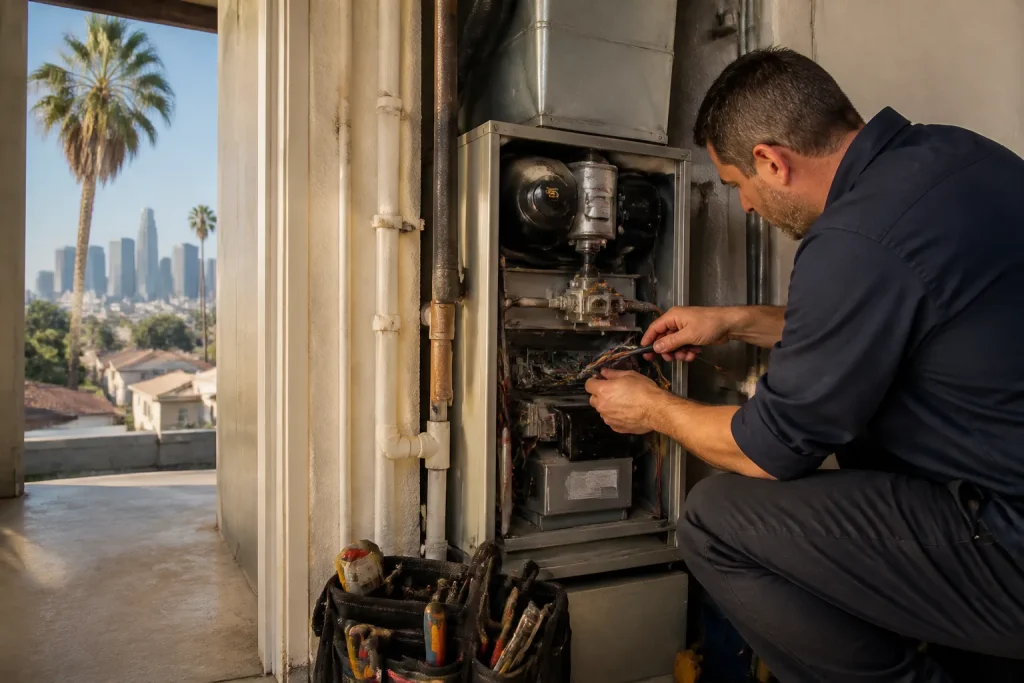
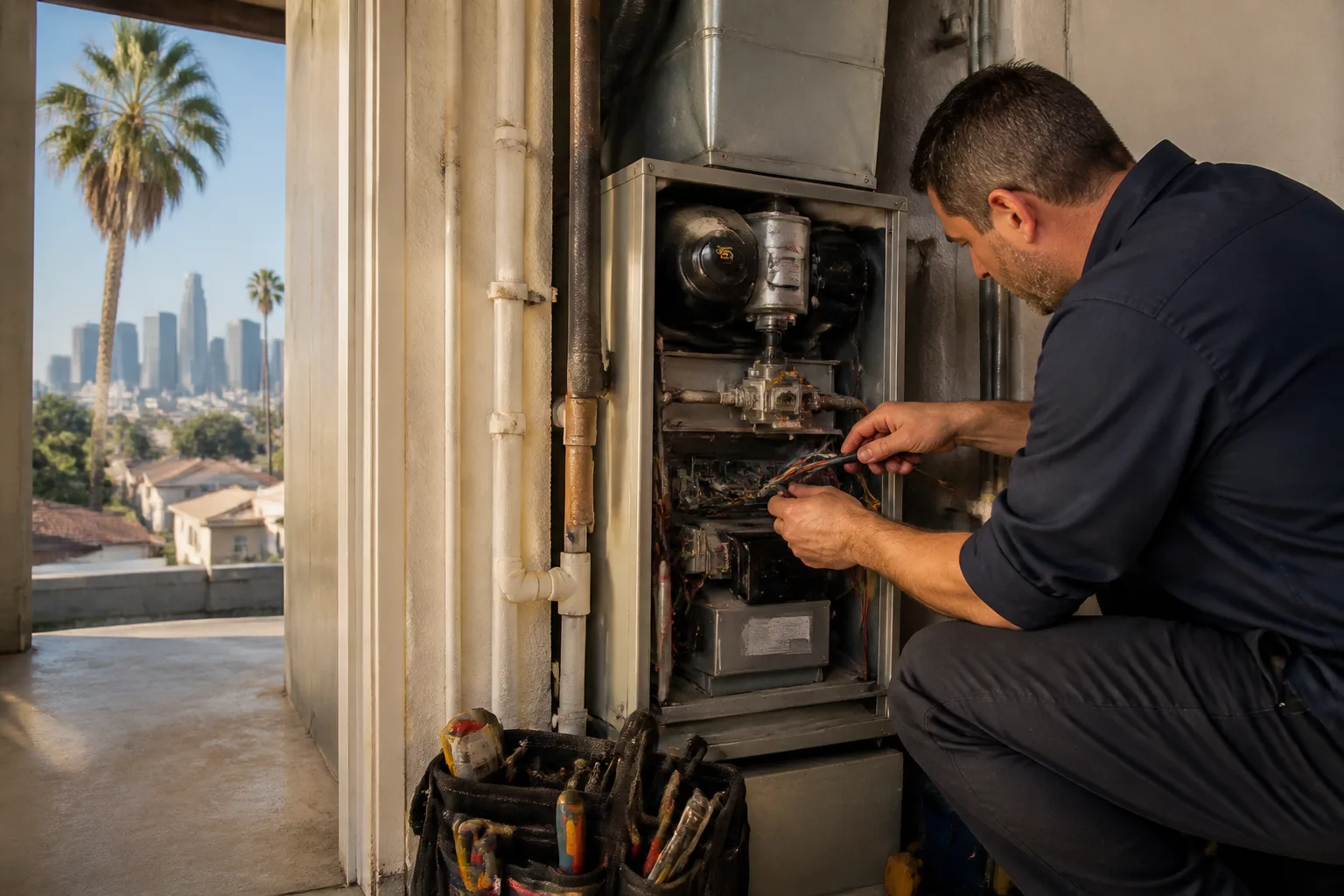
## 5 Mistakes to Avoid With Furnace Repair
Most furnace repair mistakes aren’t made by technicians with a wrench in hand. They’re made by homeowners in the first ten minutes of a service call, when someone approves a parts swap without a written diagnosis, waves off a critical inspection, or asks a handyman to rebuild combustion equipment. In Los Angeles, where furnaces cycle intermittently and failures often hide until the coldest inland nights, those early decisions decide whether you pay once for the actual fix or three times for the guessing game. This post walks through the five most expensive furnace repair mistakes we see, what to do instead, and what a legitimate diagnostic process actually looks like.
If you’d rather skip the reading and just talk to a technician who puts the price in writing before any work starts, call (361) 306-9515 – free estimates, no obligation.
Key Takeaways
– Four of the five costliest furnace repair mistakes happen before a single component is tested.
– A written diagnosis is the difference between paying for a root cause and paying for a symptom.
– Skipping a heat exchanger inspection over an $89 fee can cost thousands in carbon monoxide liability.
– California’s C-20 HVAC licensing requirement exists for a reason – unlicensed work voids warranties and insurance.
– A real repair guarantee is written, covers labor and parts, and names the company that stands behind it.
—
## Mistake 1: Approving a Parts Swap Before You See a Written Diagnosis
Replacing a furnace ignitor without testing the control board that commands it is the HVAC equivalent of changing a fuse without finding the short. The new ignitor burns out in weeks, the same failure returns, and you’ve paid twice for the same problem because no one diagnosed the circuit that kept sending bad voltage to a good part.
In Los Angeles, where Carrier, Lennox, Goodman, and Rheem systems all age differently depending on exposure to coastal moisture or inland dust, this mistake shows up constantly. A furnace that won’t light could be the ignitor, the draft inducer, the pressure switch, the gas valve, the control board, or a broken thermostat wire – and a technician who skips the diagnostic sequence is guessing as much as you would be.
A legitimate diagnostic process looks like this:
1. Verify the thermostat call is reaching the control board
2. Confirm line voltage is present at the furnace
3. Test the draft inducer starts and proves airflow through the pressure switch
4. Test that the pressure switch closes and holds
5. Verify the ignitor receives proper voltage and glows at full brightness
6. Confirm the gas valve opens and the burner lights
7. Test the flame sensor’s milliamp signal while the burners run
8. Run the blower through a full cycle and test the limit switch
A shortcut looks like this: the tech sees no ignition, swaps the ignitor, gets paid, and leaves. When the furnace fails again two weeks later, the control board was the culprit all along, sending intermittent voltage that cooked the new ignitor. You now pay for the board and a second ignitor.
Before approving any repair in your Los Angeles home, ask this question: “Can you show me in writing which component failed and what test confirmed it?” A legitimate technician writes the diagnosis down, explains it in plain terms, and quotes you a price before ordering a part. At Dalton Heating & Air, the price is in writing before any work starts, every time, on every job. That’s not a preference – it’s the standard our crews operate under, and it’s the standard that prevents parts-swap roulette.
—
## Mistake 2: Skipping the Heat Exchanger Inspection Over the Service Call Fee
The heat exchanger is the metal chamber inside your furnace that holds the flame and transfers heat to the air without letting combustion gases mix into your breathable air. When it cracks – and they do crack, especially on systems more than 12 years old, and especially in Los Angeles where long idle seasons allow rust to form from humidity and coastal air – carbon monoxide leaks into your ductwork instead of up the flue.
A cracked heat exchanger is not a comfort problem. It’s a carbon monoxide problem.
The mistake looks like this: a homeowner hears a rattle or smells something faintly off, calls for a furnace inspection, then balks at the $89 service call fee and tells the tech to “just tune it up” without checking the exchanger. The tune-up happens, the crack goes unseen, the furnace runs fine until a cold February night in the Valley, and now that crack has widened under heat stress.
In our experience around Los Angeles neighborhoods from Sherman Oaks to Pasadena, the cost trade-off is stark. A heat exchanger inspection is part of any legitimate service call – it takes fifteen minutes with a scope or combustion analyzer. The alternative, if a crack goes undetected, includes a furnace replacement at $3,800 to $7,500 for a mid-size home, plus whatever medical bills and remediation costs follow a carbon monoxide exposure event. One of those numbers is manageable. The other alters a family’s health history.
You can request a heat exchanger inspection during any maintenance visit. If a tech tells you it’s not necessary or they don’t have the equipment to do it, thank them and call someone who does. A combustion analyzer and a scope are basic tools for any company whose crews service the major brands – Trane, Rheem, York, Bryant, and the rest. Anything less is a shortcut dressed up as a discount.
—
## Mistake 3: Letting a Tech Relight a Pilot or Reset a Lockout Without Explaining Why It Tripped
Modern furnaces have safety lockouts for a reason. When a limit switch trips, a pressure switch opens, or a flame sensor fails, the control board shuts the system down rather than run an unsafe burn. A technician who arrives, resets the lockout, relights the pilot, and says “it’s all set” without identifying what caused the trip has not repaired anything. They’ve bought you a few days of heat and a full reset of the problem clock.
This mistake is especially common in Los Angeles because our furnaces sit idle for nine or ten months each year. A furnace that ran flawlessly in January gets shut off around March, sits through the humid coastal summer and dusty Santa Ana fall, and then refuses to fire the next winter. The causes are usually simple – a dirty flame sensor, a spider nest in the burner orifice, a weak pressure switch diaphragm, a clogged condensate drain on a high-efficiency Lennox or Goodman unit – but the cause must be identified.
Three questions to ask before approving any reset or relight:
1. “What caused the lockout?” If the answer is “the system just cycled off,” that’s not an answer. A real answer names the component and the test that confirmed it.
2. “What did you test to rule out a gas pressure or venting problem?” A furnace that trips a limit switch due to low airflow is a different repair than one that trips due to an overheating chamber. Without a static pressure test and temperature rise check, the tech is guessing.
3. “What happens if it trips again tonight?” A legitimate company has an answer – usually a return visit at no charge under a written guarantee. A tech without that answer doesn’t expect their work to hold.
Resetting a lockout without diagnosis turns a $150 flame sensor cleaning into a $1,200 control board replacement six days later. We’ve seen it happen enough times around Los Angeles that our standard on any lockout call is written confirmation of the cause, the test, and the fix before the system gets reset. The Garrison Code requires it: do the job by the book, and if the work does not hold, return at no charge.
—
## Mistake 4: Using a Handyman or Appliance Repair Tech for Furnace Work in California
This one costs Los Angeles homeowners more than any bad diagnostic, because the damage doesn’t show up until the system fails again or the insurance claim gets denied.
California requires a C-20 HVAC contractor’s license to repair, install, or service heating and cooling equipment. That requirement exists because furnaces combine live electricity, natural gas, combustion byproducts, and forced airflow – a combination with real consequences when handled wrong. A handyman tightening a gas union with the wrong thread sealant creates a slow leak no one detects until a pilot flame finds it. An appliance repair tech who doesn’t test combustion analysis after adjusting a burner leaves carbon monoxide output above safe levels and walks away.
Here’s what goes wrong when unlicensed work touches your furnace:
– Manufacturer warranty voidance. Carrier, Trane, Lennox, Goodman, Rheem, York, Daikin, Bryant, and American Standard all condition warranty coverage on installation and service by a licensed contractor. If an unlicensed tech installs a part and that part fails, the part’s warranty claim is denied. You own a dead compressor or heat exchanger at full retail cost.
– Homeowner’s insurance coverage denial. If an unlicensed repair is determined to be a contributing factor in a fire or gas leak, most policies decline the structural and liability claims. The insurance company doesn’t pay for work that should never have been performed.
– No contractual path to recourse. A licensed contractor is bound by the Contractors State License Board and can be held accountable. A handyman with a truck and a Google listing can disappear in an afternoon.
In Los Angeles, we’ve pulled more than one wiring splice, gas connection, and “universal” control board out of furnaces that a well-meaning neighbor or app-hired handyman had touched. The fastest way to turn a $200 repair into a $5,000 replacement is letting the wrong person open the cabinet. Check the license. Verify it’s a C-20. Ask for the number before the tech arrives.
—
## Mistake 5: Accepting a Verbal “We Stand Behind Our Work” Instead of a Written Guarantee
Every contractor says they stand behind their work. The phrase costs nothing. What matters is what happens in writing when the repair fails – because some percentage of repairs always fails, on every brand, in every city, and the question is whether you’re the one paying for the second visit.
A real labor warranty covers three things in writing:
– The labor. If the same repair fails within the guarantee period, the company returns and performs the diagnostic and repair labor at no charge. Not a “discount,” not a “come back and we’ll take a look” – zero charge.
– The part. If the replacement component fails, the part is covered under its manufacturer warranty, and the labor to install the replacement part is also covered. No re-installation fee disguised as a “warranty service charge.”
– The terms. The guarantee period is stated in months or years, not “reasonable time.” The company name is printed on the document. The guarantee applies even if the tech who did the original work no longer works there. No fine print that excludes “acts of the equipment.”
What “we stand behind our work” means without paper – nothing enforceable. If the repair fails at 2 a.m. and the tech doesn’t show up, you’re calling a new company and paying full price for a second repair of the same component.
At Dalton Heating & Air, every repair carries a written guarantee: if the work does not hold, we return at no charge within the guarantee period. That’s the 365-Day Done Right Promise, and it includes a free second visit when the repair fails. It’s not an upgrade, not an upsell – it’s printed on every service ticket. Marco Benitez, who runs our Los Angeles operation, started with this brand because the alternative – verbal promises and voicemail guarantees – was what homeowners kept calling him to fix.
When to call a pro: If your furnace is making a banging sound from the cabinet, if you smell gas anywhere near the unit, if the burner flame looks yellow or flickering instead of steady blue, or if a carbon monoxide detector has gone off – turn the system off and call a licensed C-20 contractor. These are not DIY diagnostic moments. They’re the moments a legitimate company answers the phone at any hour, with a real person, because they know a furnace issue in Los Angeles at 2 a.m. in December isn’t waiting for business hours.
Related services in Los Angeles: If this post surfaced questions about your own system, we cover the full range: Dalton Heating & Air home services all nine major residential brands, Furnace Repair in Los Angeles for no-heat calls and diagnostics, AC Repair in Los Angeles for the other half of the year, and Heat Pump Installation in Los Angeles for replacements and new builds. One company, one phone number, a real person on the other end every time.
—
## The Bottom Line
Four of the five most expensive furnace repair mistakes happen before a single component gets tested. Approving a parts swap without a written diagnosis, skipping a heat exchanger inspection over a service call fee, and letting a tech reset a lockout without identifying the cause are all ways to pay twice for the same failure. Hiring an unlicensed tech compounds the cost through voided warranties and denied insurance claims, and accepting a verbal guarantee instead of a written one removes your only leverage when the work doesn’t hold.
In Los Angeles, where furnaces sit idle for most of the year and failures cluster in the first cold weeks, the pattern repeats every winter: a homeowner approves the fastest fix, pays for it, and calls again seven weeks later with the same no-heat situation and half the patience.
The fix is not complicated. Ask for the diagnosis in writing before approving a repair. Ask what test confirmed the failure. Ask what happens if the trip reoccurs. Verify the license. Get the guarantee on paper with a company name attached to it.
If you’re in Los Angeles and need help, Dalton Heating & Air offers free estimates. Call (361) 306-9515 – a real person answers, every time.
—
## Frequently Asked Questions
Should I repair or replace my furnace?
Repair is usually the right call when the heat exchanger, cabinet, and control board are sound, and the failure is isolated to a component like an ignitor, flame sensor, pressure switch, or gas valve. Most furnace repairs in Los Angeles run $150 – $450 depending on the part and access. Replacement makes sense when the heat exchanger is compromised, the system is over 15 years old and repeatedly failing, or the efficiency drop has begun showing up on your gas bill every month. A new mid-efficiency furnace for a standard Los Angeles home runs $3,800 to $7,500 installed. Call (361) 306-9515 for an exact quote – estimates are free.
Can you really diagnose a furnace in one visit?
Yes, for the majority of failures. A C-20 licensed technician with a combustion analyzer, multimeter, and the ability to read manufacturer fault codes on the major brands (Carrier, Trane, Lennox, Goodman, Rheem, York, Daikin, Bryant, American Standard) can isolate a no-heat cause in thirty to sixty minutes. Some intermittent failures take a second visit if the problem only appears under specific conditions, which is why a written repair guarantee matters – that second visit should not cost you anything.
What does a furnace repair guarantee actually cover?
A legitimate written guarantee covers the labor to return and re-diagnose the same failure, the labor to remove and reinstall a failed part, and it runs a stated period (a full year at Dalton Heating & Air, not a 30-day window). It names the company, applies regardless of which tech performed the original work, and includes a free return visit if the repair fails within the period. If the guarantee is spoken but not printed, it does not exist.
Are there rebates or financing available for furnace replacement in Los Angeles?
Yes, depending on the system type. Heat pump installations and high-efficiency furnace replacements often qualify for federal tax credits and utility rebates through LADWP and SoCalGas, and the amounts shift by year. Dalton Heating & Air handles the rebate paperwork and financing documentation at no additional cost. Call (361) 306-9515 and ask – we’ll check what applies to your specific zip code and system type.
—
Written by Marco Benitez, Owner at Dalton Heating & Air, serving Los Angeles since 2003.
Need HVAC Help?
Call Dalton Heating & Air - licensed & insured, here with fast after-hours help in Los Angeles.
(361) 306-9515