
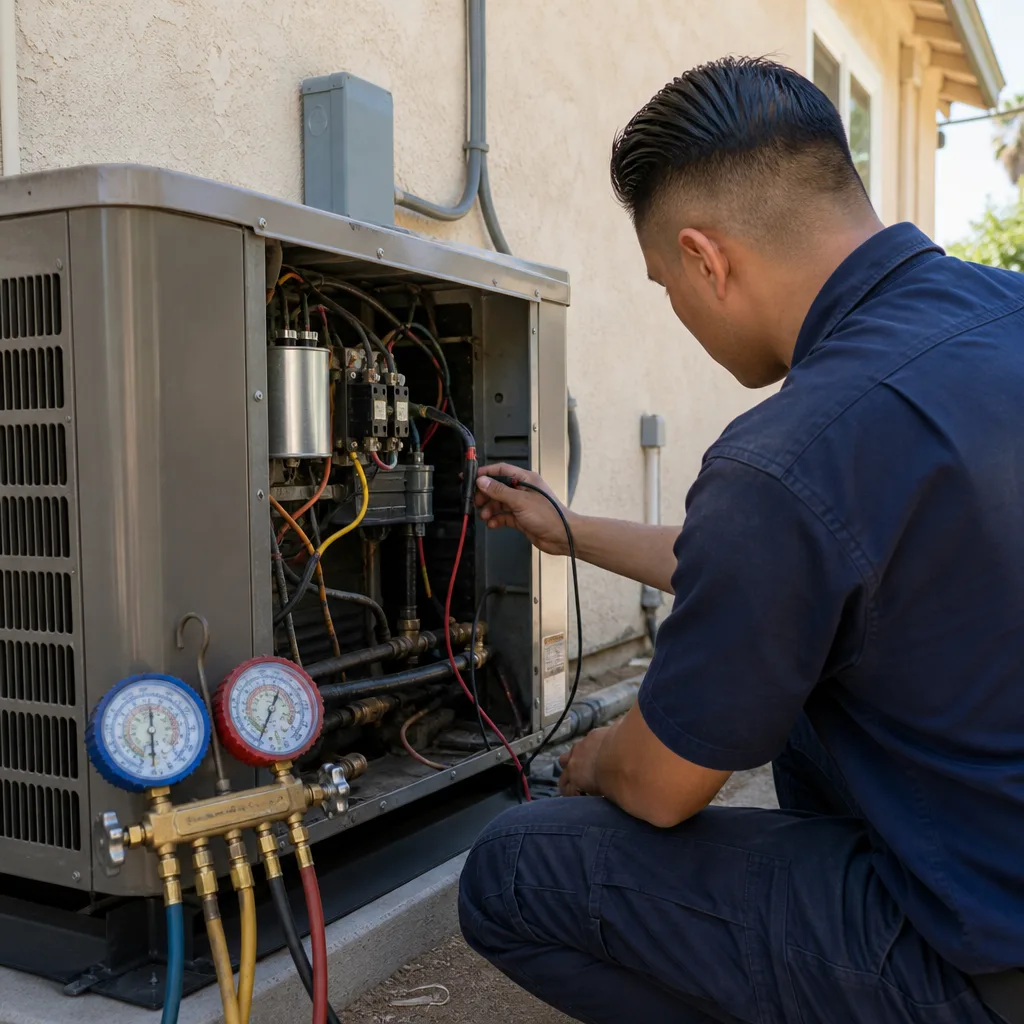
Seasonal tune-up and full diagnostic on your Carrier, Trane, or Goodman system - readings shown to you before any repair is proposed
Diagnosis first, numbers second - you approve the repair price before a single part goes in.
 Before
 After
After Before
 After
After Before
 After
AfterDaikin Thermostat Installation: The Los Angeles Owner’s Guide
We install and replace Daikin thermostats across Los Angeles, and most jobs run between $310 and $690 installed, including the part, the wiring, and a full system test. If you call before noon on a weekday, we can often have a technician out the same day. The part has failed when your Daikin system runs constantly or won’t kick on at all, the room temperature on the display doesn’t match what you feel, or the screen is blank even after fresh batteries. Los Angeles homes with older Daikin units often see thermostat failures after power surges from summer grid strain, and we keep common Daikin-compatible replacements on the truck so we’re not making two trips.
Which Daikin Models This Applies To
Daikin has used several thermostat families across its residential lineups, and the connector style is where owners get tripped up. If you have a newer Daikin mini-split, you’re likely looking at the BRC or ARC remote-style controllers, which run on a proprietary communicating protocol, not standard 24-volt wiring. Older Daikin split systems and heat pumps often use a conventional wired thermostat plate with standard R, C, Y, W, and G terminals, which gives you more flexibility on replacement options. The fastest way to know what you need is to pull the thermostat off its base and look at the terminal block: if you see screw terminals labeled with letters, you have a standard 24-volt setup; if you see a flat ribbon connector, you need a Daikin-specific communicating controller.
On the OEM versus aftermarket question: for mini-splits and variable-speed Daikin systems, we recommend staying with Daikin OEM controllers because the communication signal is proprietary and a generic thermostat simply won’t talk to the indoor unit correctly. For older 24-volt systems, a quality aftermarket thermostat like a Honeywell or an ecobee works fine, and we’ll program it to match your Daikin equipment’s staging behavior. One thing we see in Los Angeles regularly: owners with older Daikin ducted systems buy a smart thermostat on sale, install it themselves, and then call us because the system short-cycles or the reversing valve doesn’t engage. The thermostat wiring at the board doesn’t always match the color-coded wiring at the wall, and that mismatch is the root cause more often than a bad part.
Signs Your Daikin Thermostat Installation Is Failing
- Blank or dim display with fresh batteries: This usually means the thermostat’s internal board has died or the incoming low-voltage wire has a short. If the transformer in the air handler is still good, the problem is almost always the thermostat itself.
- Room temperature reads 5 to 8 degrees off from a separate thermometer: The thermistor, the small heat-sensing component inside the thermostat, has drifted out of calibration. You can adjust offsets on some models, but if it’s off by more than a few degrees, replacement is the honest fix because the drift will continue.
- System cycles on and off every few minutes: This is short cycling, and in Los Angeles it often follows a thermostat that’s been exposed to direct afternoon sun or a draft from a nearby window. The thermostat reads the wrong temperature, satisfies too early, then calls for cooling again minutes later. It’s hard on the compressor.
- The thermostat calls for cooling but the outdoor unit never starts: Before assuming it’s the thermostat, we test the low-voltage signal at the board. If the thermostat is sending 24 volts but the contactor isn’t pulling in, the problem is downstream. If there’s no voltage at the Y terminal when cooling is called for, the thermostat’s relay has failed.
- Buttons or touchscreen respond intermittently: The tactile switches or touch panel have worn out, or the internal solder joints have cracked from years of temperature swings. Once the interface becomes unreliable, you’re chasing a part that’s already done.
Replacement Cost & What’s Included
In Los Angeles, Daikin thermostat replacement with Dalton Heating & Air typically runs $310 to $690 installed. The spread comes down to what you’re replacing. A standard 24-volt Daikin-compatible thermostat with a basic wired install lands toward the lower end. A Daikin OEM communicating controller for a mini-split, which is a more expensive part and requires the system to be matched to the controller through its service menu, lands toward the upper end. Every quote includes the part itself, the labor to remove the old unit, proper mounting and leveling, wiring verification at both the thermostat and the air handler, programming for your equipment, and a system run test to confirm heating and cooling both respond correctly.
The price you’re quoted is the price you pay. We write it down before any work begins, and the repair is guaranteed in writing for a full year under our 365-Day Done Right Promise. If the thermostat or the installation fails within that year, we return at no charge. That’s The Garrison Standard, and it applies to every job we do, no exceptions.
DIY or Call Us?
Replacing a thermostat on a standard 24-volt system is one of the more approachable DIY jobs in HVAC, but there’s a real catch: if you miswire it, you can blow the low-voltage fuse on the control board or, in a worst case, send high voltage somewhere it shouldn’t go and damage the board itself. That turns a $310 thermostat swap into a $700 board replacement. The dangerous part isn’t the thermostat; it’s the air handler, where 240-volt power is present. Before you open anything, kill the breaker to the indoor unit and the outdoor unit, and if you have any doubt about which of those two breakers feeds the air handler, stop and call us. We’ve fixed enough DIY installs in Los Angeles to know that the second trip usually costs more than hiring it out the first time.
For Daikin mini-split and variable-speed systems with communicating controllers, this isn’t a DIY job at all. The controller has to be addressed to the indoor unit, and if it’s not done correctly, the system will throw error codes or refuse to run. Call us at (361) 306-9515 and we’ll get it done right the first visit.
FAQs
A Daikin thermostat typically lasts 8 to 12 years in Los Angeles, though homes near the coast tend to get a little more life because the indoor temperature swings are smaller. Communicating controllers on mini-splits can fail sooner if the unit is in a wall that gets direct afternoon sun, which cooks the internal board.
Most thermostat failures are not worth repairing. The internal board, thermistor, and relay components are not sold separately by Daikin, and a repaired board carries no realistic warranty. The practical repair is replacement, and for the cost difference between a band-aid fix and a new unit, replacement is the honest long-term answer.
A standard Daikin thermostat replacement takes 45 to 90 minutes on site. If we discover wiring damage at the air handler or need to fish a new thermostat wire through the wall, add another 30 to 60 minutes. Communicating controller programming adds about 15 minutes because the indoor unit and controller have to be paired.
We stock common Daikin-compatible wired thermostats and several Daikin OEM communicating controllers on our service vehicles in Los Angeles. If we don’t have your exact model on the truck, our parts supplier has next-day availability on nearly every Daikin residential controller, and we’ll give you a firm install date before we leave.
Written by Marco Benitez, Owner & Lead HVAC Technician, Dalton Heating & Air at Dalton Heating & Air, serving Los Angeles and nearby areas.